


Want to make fragrances at home but aren’t sure how?
Follow our easy ‘how to make perfume : a beginners guide’.
So you want to embark on the path of fragrance creation. That’s great! For some the task can seem a little daunting, but don’t worry, our step by step guide is here to get you started and will help you make your nose happy. Here we go…
STEP 1: Get yourself a scale
Get your hands on a small scale – never use drops! Measuring your ingredients in grams is a lot more accurate when you want to make and recreate your formula.
Drops may seem easier, but it’s very hard to get the same amount of ingredient in every drop. Before you know it, you can end up with a rather interesting formula that will be quite difficult to tweek and difficult to recreate!
You don’t need to invest in an expensive Lab scale to start of with. A small 0.01gram precision scale will be enough to start and you can upgrade to a 0.001g precision scale later. You’ll find plenty of mini scales online from £20 to £40, but if your budget allows, you’ll find a professional scale at an entry price of around £400-500.
STEP 2: Source your ingredients from reliable companies
Get yourself some good ingredients: industry-grade standard perfumery ingredients are hard to find when purchased in small quantities so this step will require a bit of research, especially if you want to ensure you get ingredients of the highest quality.
At EPC, our activity as perfumers allows us to source the best ingredients you can possibly find, from reputable suppliers such as IFF-LMR, Symrise and Firmenich. We have put together a few ingredients box sets which allows you to build your ingredient collection up to 60 of the most used perfumery raw materials. These ingredients have been specially selected to get you started, and more importantly, are already diluted in perfumer’s alcohol, so that you can ensure a more satisfying result, even at beginner’s level.
STEP 3: How to formulate
Think about your brief first
Now comes the creative part. When you’re at this stage, really think about what you want to create, this is called a “brief”. What type of scent do you want to make, is it floral or woody or a combination of both? Do you want to make a light, airy fragrance or a deep, sensual scent? Do you want your fragrance to star one or two single notes, or more (i.e.: Rose or Cedarwood)? Think around all of these things and more, or simply about a creative story or memory you’d like to achieve.
A fragrance is a complex formula that can include dozens of ingredients, but we’d recommend to train with a combination of just a few (10 or less).
There is no book on formula, perfumery is a knowledge that gets passed on from perfumers to perfumers and with a lot of hard work and dedication.
How to write a perfume formula
Spend a bit of time at this stage so you’re focused on your end perfumery goal. A formula is typically written out of 100% (or out of a total of 1,000 or 10,000 when you are more advanced). Keeping a clear consistent total allows you to understand the impact of each individual ingredient within the overall formula as well as helping when it comes to reworking your formulae.
Top tip: Always write your formula down – we’d hate for you to loose the formula that made you irresistible!
Step 4: Evaluate and rework your formula
Smell on Scent Strips not from the bottle:
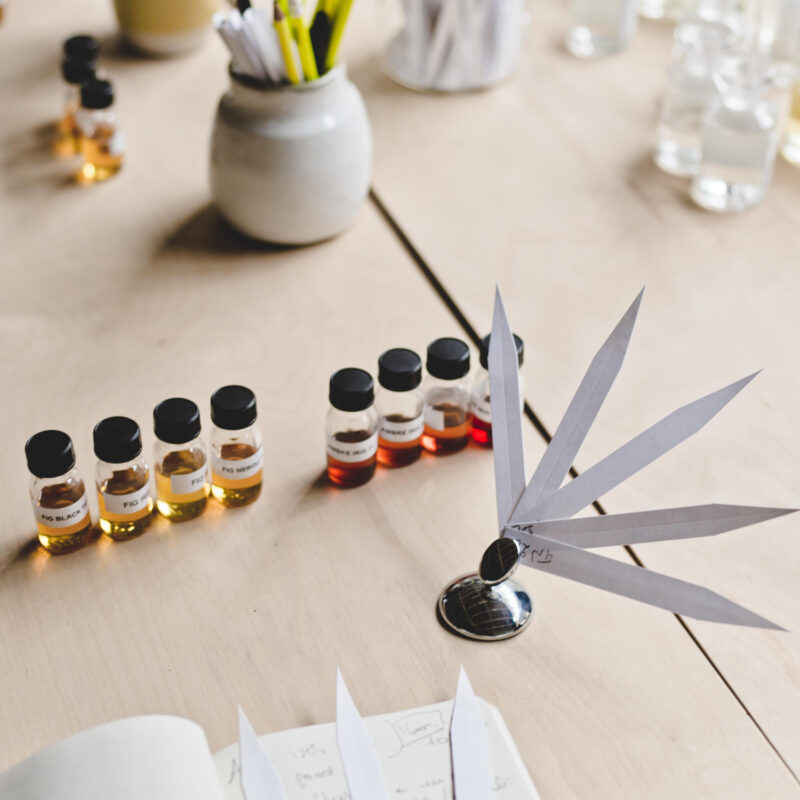
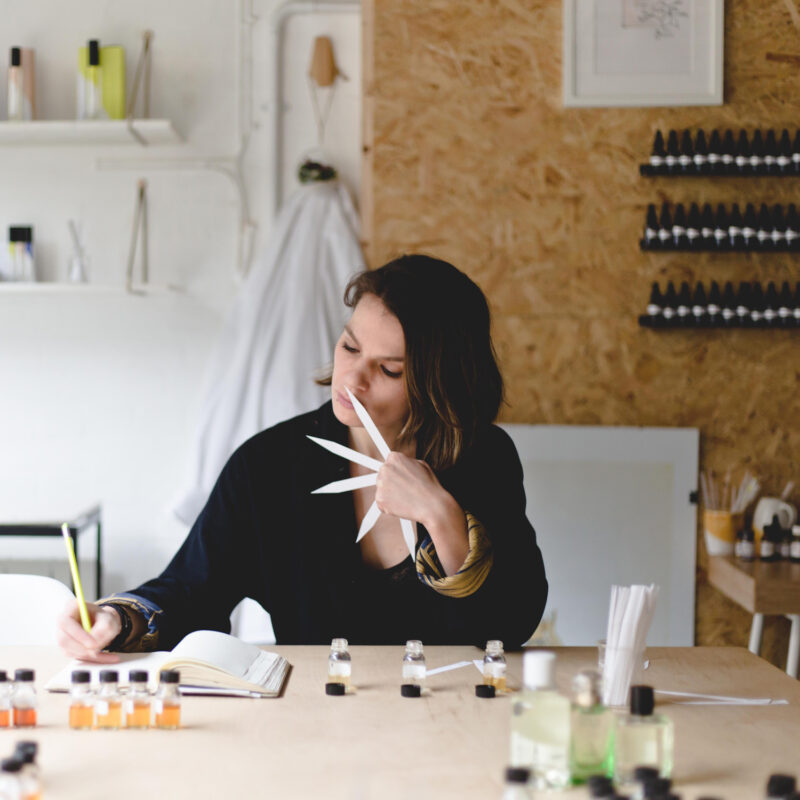
Once you’ve weighed your first formula, give it a gentle shake and evaluate the result on a scent strip (the paper types you find in fragrance retailers). Scent strips come in all shapes and sizes : the most commonly used have square ends (good for smelling ingredients) or pointy ends (good for smelling perfumes). You can start off with these standard scent strips. If you get pointy scent strips, dip your scent strip on the pointy end and smell it without touching your nose.
The rework stage:
Once you’ve assessed what’s good and what’s less good, you’re ready for a rework of your idea by tweaking the formula. And so on… Until you’re happy (sometimes it can take hundreds of trials to get it right, so be patient!).
STEP 5: Dilute your ingredients or composition
But how do I dilute to 10% ?! This involves some basic math but we know it’s not always as easy as it sounds… 10% in alcohol means you will dilute 1g of your ingredient or composition (pure) and add 9g of alcohol (so the total is 10g). If your ingredient is very powerful, you may even want to dilute it at 1% in alcohol. So essentially, that means 0.1g of your ingredient that you complete with alcohol up until you reach 10g.
Follow our easy ‘how to make perfume : a beginners guide’.
So you want to embark on the path of fragrance creation. That’s great! For some the task can seem a little daunting, but don’t worry, our step by step guide is here to get you started and will help you make your nose happy. Here we go…
STEP 1: Get yourself a scale
Get your hands on a small scale – never use drops! Measuring your ingredients in grams is a lot more accurate when you want to make and recreate your formula.
Drops may seem easier, but it’s very hard to get the same amount of ingredient in every drop. Before you know it, you can end up with a rather interesting formula that will be quite difficult to tweek and difficult to recreate!
You don’t need to invest in an expensive Lab scale to start of with. A small 0.01gram precision scale will be enough to start and you can upgrade to a 0.001g precision scale later. You’ll find plenty of mini scales online from £20 to £40, but if your budget allows, you’ll find a professional scale at an entry price of around £400-500.
STEP 2: Source your ingredients from reliable companies
Get yourself some good ingredients: industry-grade standard perfumery ingredients are hard to find when purchased in small quantities so this step will require a bit of research, especially if you want to ensure you get ingredients of the highest quality.
At EPC, our activity as perfumers allows us to source the best ingredients you can possibly find, from reputable suppliers such as IFF-LMR, Symrise and Firmenich. We have put together a few ingredients box sets which allows you to build your ingredient collection up to 60 of the most used perfumery raw materials. These ingredients have been specially selected to get you started, and more importantly, are already diluted in perfumer’s alcohol, so that you can ensure a more satisfying result, even at beginner’s level.
STEP 3: How to formulate
Think about your brief first
Now comes the creative part. When you’re at this stage, really think about what you want to create, this is called a “brief”. What type of scent do you want to make, is it floral or woody or a combination of both? Do you want to make a light, airy fragrance or a deep, sensual scent? Do you want your fragrance to star one or two single notes, or more (i.e.: Rose or Cedarwood)? Think around all of these things and more, or simply about a creative story or memory you’d like to achieve.
A fragrance is a complex formula that can include dozens of ingredients, but we’d recommend to train with a combination of just a few (10 or less).
There is no book on formula, perfumery is a knowledge that gets passed on from perfumers to perfumers and with a lot of hard work and dedication.
How to write a perfume formula
Spend a bit of time at this stage so you’re focused on your end perfumery goal. A formula is typically written out of 100% (or out of a total of 1,000 or 10,000 when you are more advanced). Keeping a clear consistent total allows you to understand the impact of each individual ingredient within the overall formula as well as helping when it comes to reworking your formulae.
Top tip: Always write your formula down – we’d hate for you to loose the formula that made you irresistible!
Step 4: Evaluate and rework your formula
Smell on Scent Strips not from the bottle:
Once you’ve weighed your first formula, give it a gentle shake and evaluate the result on a scent strip (the paper types you find in fragrance retailers). Scent strips come in all shapes and sizes : the most commonly used have square ends (good for smelling ingredients) or pointy ends (good for smelling perfumes). You can start off with these standard scent strips. If you get pointy scent strips, dip your scent strip on the pointy end and smell it without touching your nose.
The rework stage:
Once you’ve assessed what’s good and what’s less good, you’re ready for a rework of your idea by tweaking the formula. And so on… Until you’re happy (sometimes it can take hundreds of trials to get it right, so be patient!).
STEP 5: Dilute your ingredients or composition
But how do I dilute to 10% ?! This involves some basic math but we know it’s not always as easy as it sounds… 10% in alcohol means you will dilute 1g of your ingredient or composition (pure) and add 9g of alcohol (so the total is 10g). If your ingredient is very powerful, you may even want to dilute it at 1% in alcohol. So essentially, that means 0.1g of your ingredient that you complete with alcohol up until you reach 10g.
You’ll need to also get yourself some perfume alcohol (the solvent – this will be different based on whether you want to make a candle or a room freshener). If you don’t hold an alcohol license (which is unlikely if you are a casual maker), we find Mistral ‘s perfumer’s alcohol to be reliable and of high quality. For beginners, and in order to waste less ingredients, we recommend to pre-dilute your ingredients at 10% to make things a little easier.
Dilution in alcohol is an essential step as it makes smelling fragrance much more approachable, while smelling a blend of ingredients pure will feel overwhelming and compact.
How to dilute your ingredient or composition:


